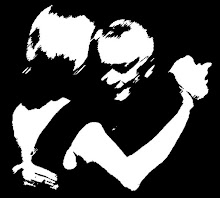
Ever stepped onto a milonga dance-floor, only to find that all creativity has deserted you?
Here's some advice for a start: keep it simple, focus on the music, and choose the right partner.
Improvisation is not random and chaotic, says Michael Gladwell in his best-selling book, Blink. When talking about how elite basketballers train in order to play intuitively (e.g. the instant, magic pass after no more than a glance), he could be talking equally about tango dancers when he says that spontaneity is only possible after engaging in hours of highly repetitive and structured practice.
Swedish professor of psychology Anders Ericsson said that deliberate practice begins in the brain: focused, repetitive training in which the person is always monitoring their performance, correcting, experimenting, listening to immediate & constant feedback, investing a significant amount of time. For the tango dancer, that means continuing to practise tango's fundamental skills - the walk, pivots, ochos, etc., no matter how experienced the dancer is, just like concert pianists practise their scales.
Improvisation in tango appears to be under-pinned by a couple of essential elements:
1) a repertoire of well-practised movements, which could amount to no more than a good tango walk, simple ochos, changing direction, and a variety of timing to go with them, ........ or the repertoire may be more extensive.
2) an ability to really hear the music - its rhythms, melodies, moods, timing changes.
Of course, you then need to move to the next level - an ability to actually connect with the music: responding to it in a manner that reflects its rhythms & emotions, and using movements (figures or segments of figures) & timing that allow this to happen.
On the dance-floor, however, at the moment you start becoming reflective about your dance, your ability to improvise is undermined - you lose the flow. The dance then starts to take place in your head (leader's & follower's), and all creativity & the possibility of quick responses to changes in rhythm or melody are lost. For the dancer who improvises well, the responses & figures come from the body; to suddenly introduce a newly-learned, but not sufficiently practised sequence on the dance-floor, is courting failure, because introspection is bad for improvisation. Planning, calculating assessing, remembering (sequences, for example) kill improvisation. While response to music is a right-brain activity, introspection on the other hand is left-brain, and will quickly over-ride creativity. This means that thinking about or trying to remember sequences is more than just a simple distraction from the music - it actually subverts improvisation.
In other words, keep the dance simple, using well-practised movements (as opposed to 12-16 step rigid sequences), responding to the music in connection with your partner. One of the most important rules that makes improvisation possible is the idea of agreement, writes Martin Gladwell. So in tango, we probably look for partners who follow the same "rules" as us, for example in relation to embrace, lead-follow, musicality, emotional response. Is it any wonder that we may look for particular partners when a vals tanda begins, or Pugliese? Or maybe bypass a tanda that we have no feeling for?
For me, genuine improvisation will only occur when I connect with the music and I connect with my partner. From here, I'm transported into the dance by the music, with my body drawing from a relatively small bag of movements that have been embedded after several thousand uses - and only then can the experience be heightened by playing with the timing. For me, there is no other tango!
It's worth looking at videos of Buenos Aires milongueros improvising in this Tango and Chaos chapter.
Bob.
Bob.